
Home › The Family Book
The Jasiński Family Book
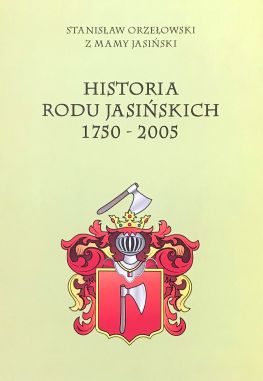
Extracts from Stanisław Orzełowski's "Historia Rodu Jasińskich 1750–2005".
Below are selected extracts from the Jasiński Family Book (it describes the branch of Jakub Jasiński, born 1752 in Jasionka), shared for the website jasinscy.org.pl by the author, Stanisław Orzełowski.
FOREWORD
This second history of noble families from the pen of Stanisław Orzełowski, now placed in the reader's hands, is a valuable record of the story of the Jasiński family. The history of the noble families of southern Podlasie opens with "Historia Rodu Orze(y)łowskich 1750-2001", published by Stanisław Orzełowski in 2003. Its motto was: "Our identity is woven from the memory of those close to us". It belongs among those works that set down, with great care, detail and devotion, the complex history of a family in hard times: the loss of independence, the Podlasie Martyrs, two world wars, repeated occupations, and the constant readiness of Poles to rise for their country, to regain independence and to keep their national, religious and economic identity. The author dedicated the first book to his parents – Marianna-Janina née Jasińska and Franciszek Orzełowski.
Read the extract (PDF, 38 KB)
FROM THE AUTHOR
This book was not written on my inspiration alone. With the writing of the Historia Rodu Orze(y)łowskich still fresh in my memory, and knowing how much work it had taken, I would not have dared to set out on a second book by myself. Still, at every opportunity that came my way, I gathered material on the genealogy and history of the Jasiński family, the family my mother came from.
Read the extract (PDF, 562 KB)
HOW THE IDEA OF WRITING THE FAMILY'S HISTORY WAS BORN
The Jasiński family, to which I belong through my mother Marianna-Janina (B-411), is very close to my heart. My attachment to it began in childhood, when my grandmother Leokadia-Helena (B-41) Jasińska, my mother's mother, used to come to our family home in Plewki. My mother, caught up like every mother in a thousand duties — the house, the farm and the raising of nine children — had no time, and perhaps no inner need, to say much about her family.
Read the extract (PDF, 91 KB)
AN INTRODUCTION TO THE HISTORY OF THE JASIŃSKI FAMILY TREE
At the fifteenth kilometre of the road from Siedlce to Terespol, four kilometres before the settlement of Zbuczyn and just past the village of Ługi Gołacze, a signpost tells you that 2.5 km to the right of the road lies the village of Jasionka. According to the 1531 tax register of the Łuków district, the village is recorded as a nobles' village, in which Antoni Jasiński (Wojcieszyk) and his co-sharers pay, from the 4 włóki of land they plough themselves – 8 florins, and from the cottages without fields – 4 florins 8 groszy – facit 12 florins 8 groszy.
Read the extract (PDF, 1408 KB)
THE NOBLE VILLAGE OF THE JASIŃSKI FAMILY - JASIONKA AND ITS SURROUNDINGS: A LITTLE GEOGRAPHY AND HISTORY
Jasionka, the ancestral village of the Jasińskis, lies on the border between the Siedlce Upland and the Łuków Plain. Historically this is the edge of the old Łuków Land (ziemia łukowska), which from the end of the 15th century until the partitions of Poland belonged to the Lublin and the Podlasie voivodeships. It was an exceptionally unsettled region, especially after the will of King Bolesław Krzywousty divided Poland into duchies among his sons, and the country lost its strength.
Read the extract (PDF, 16315 KB)
THE NOBLES' COMMONWEALTH
To understand the spiritual bonds of that political construction called the Polish Commonwealth, to judge fairly the expressions of Polish historical thought and to take in the nation's past, one has to know the history of that vast social class we know as the POLISH NOBILITY. It should be said that the nobility in Poland was not, as it was elsewhere, a thin upper layer; it formed an enormous, exceedingly numerous part of the nation, more numerous than in any other country in Europe. That size was a distinctive feature of Polish society. While France at the end of the 18th century had 140 thousand nobles among 20 million inhabitants, that is under 1%, the Polish Commonwealth, with 10 million inhabitants, counted at the same time more than 1 million, and some historians give even 1 million 300 thousand nobles, which is 10-13% of the whole population.
Read the extract (PDF, 55 KB)
HOW SURNAMES CAME INTO BEING
In the first Polish Commonwealth surnames existed, but not for everyone. As a means of identification they entered Polish legal thinking only in the second half of the 18th century, and it was the partitioning powers that made them compulsory.
Read the extract (PDF, 48 KB)
A FEW WORDS ABOUT OUR COAT OF ARMS, "TOPÓR"
The nobility played a great part in shaping the history and culture of Poland in centuries past. The mark of that estate was the coat of arms. Ennoblement — the granting of arms and recognition as a nobleman — was until 1578 the king's own act, later the king's under the control of the Sejm, and finally, from 1601, the Sejm's, that is the nobility's own through its representatives. The coat of arms was placed above the entrance to palaces and manor houses, and on family signet rings. In time it became an inseparable part of Polish culture.
Read the extract (PDF, 1049 KB)
A HISTORY OF THE SIEDLCE DISTRICT
The Siedlce district was created a few years after the last partition of Poland. It was put together from five parts that lay in different districts. In the old Commonwealth such districts were most often called lands. Those "lands" were usually larger than today's districts. At that time the borders of five separate lands ran not far from Siedlce, and they belonged not to one voivodeship but to three.
Read the extract (PDF, 104 KB)
RUSSIFICATION
The period covered by my book (1750-2005), in which I describe the life of the Jasiński family, includes the years 1795-1918, the time of the partitions. For 123 years this land and the Jasiński family lived under Russian rule, and Poland as a state was erased from the map of Europe. I feel it my duty to remind my relatives living today what that meant for our ancestors then. In a few sentences I would like to show what Russification looked like here.
Read the extract (PDF, 3967 KB)
ZBUCZYN PARISH
Zbuczyn is an important place for everyone living nearby. People came here not only to pray in the local church. From the beginning of the 15th century it was called a royal village, and that was thanks to King Władysław Jagiełło. He hunted in the forests around it, and he had a road marked out through here that he took from Kraków to Lithuania and back. Along it, so the legend says, marched the armies going to the battle of Grunwald. Traces of the old royal road can still be made out in the woods around Zbuczyn.
Read the extract (PDF, 10271 KB)
TRADITIONS AND CUSTOMS
In one of the chapters I wrote that the world is changing before our eyes, that everything is in motion and that with every moment we move further from what once was. So it was centuries ago and so it will be in the centuries to come. Yet it is hard for a person, especially one entering middle age, to accept that something is disappearing, going for good. It is hardest of all to accept the loss of what one loved in life and held to with all one's heart. In this chapter I want to share what I lived through in the most beautiful part of life, childhood and youth. It is bound up closely with the traditions and customs of the world I grew up in. I will set them out in order, following the church year, in the hope of saving them from being forgotten.
Read the extract (PDF, 36325 KB)
FAMILY LINES ESTABLISHED OUTSIDE THE ANCESTRAL VILLAGE OF JASIONKA
Across the wide area covered by Zbuczyn parish, the Jasiński family lived at first only in Jasionka. In this book I describe the history of one of several branches of the family from the village of Jasionka, the branch my mother came from. My account covers the last 250 years. Members of this branch live today in Jasionka and close by, but also scattered all over Poland and beyond it.
Read the extract (PDF, 1513 KB)
A DESCRIPTION OF THE BOUGHS AND BRANCHES OF THE JASIŃSKI FAMILY TREE
JAKOB JASIŃSKI - the founder of the branch of the Jasiński family described here. In the church records the name Jakub was then written JAKOB. In time an accent appeared over the letter "o" and the name was written Jakób. I was not able to establish the names of Jakub's parents: they are not given in his death record, and I could not find my way in the records written in Latin. Here I felt my own shortcoming. I do not know Latin, and I never met the language at school, which is a pity.
Read the extract (PDF, 10575 KB)
MY REFLECTIONS
By nature a person always reaches for the new. He keeps improving things, keeps changing them, and finds new paths and roads over the course of his life. Sadly, he is never quite satisfied with them. What was to bring him benefit turns out to be something he did not exactly expect. So he throws himself into the chase after something unknown that might make him happy. In perfecting his tools over the centuries he has certainly lightened his labour, but in the end it has not done him good, because employers today would rather deal with a machine than with a person. So he has been left without work and without pay. Rushing on like this through life, generation after generation lost precious values that it did not yet know how to understand or judge.
Read the extract (PDF, 106 KB)
A HISTORY OF THE FAMILY REUNIONS I HAVE ORGANISED
The history of family reunions among the Jasińskis (my mother's family) and the Orze(y)łowskis (my father's family) is a rich one. The first reason for that is that I come from a large, widely spread family. There were nine of us at home, two daughters and seven sons. We grew up in an atmosphere that can be described in a single phrase: rich in family feeling.
Read the extract (PDF, 38422 KB)
CONCLUSION
Here ends the history of the branch of the Jasiński family descended from Jakub (1749) and Scholastyka née Głuchowska (1752), who lived in Jasionka, in the parish and commune of Zbuczyn, in the Siedlce district.